How manufacturing technology is changing the way industrial plants make decisions
How are leading industrial plants using manufacturing technology to maximize profitability? In this guide, we evaluate the impact of smart manufacturing on industrial competitiveness. Discover how to turn machine data into actionable information, and why tracking operational indicators and monitoring with greater precision matters.

Content
Since the mid-20th century, most decisions on the shop floor were reactive. A problem occurred, someone detected it, the cause was investigated, and a correction was attempted. Managers and engineers met early in the morning to review manual reports and travelers from the previous shift. If a production line had operated below capacity or a critical machine had failed, the discussion focused on retrospective diagnosis. They knew what had gone wrong, but the financial and operational impact was already irreversible.
While this model was applied in factories for years, it also had its drawbacks: delayed decision-making, limited operational visibility, and excessive reliance on manual reports or individual experience.
Today, the situation is changing rapidly. The World Economic Forum (WEF), through its Global Lighthouse Network, notes that the world’s leading plants have broken this paradigm by implementing new manufacturing technologies. But digitalization is not just about replacing human labor with automation. For manufacturing companies in the Americas, technology is redefining traditional processes and how day-to-day and long-term decisions are made.
Manufacturing Technology: From Intuition to Visibility
The main obstacle in a modern factory is not the absence of data. Production, downtime, energy consumption, defects, maintenance, and machine performance have been part of daily operations for decades. The real challenge lies in the inability to structure data and convert it into actionable information in real time.
To explain this problem, the German National Academy of Science and Engineering (Acatech) developed the Industrie 4.0 Maturity Index. This model divides a manufacturing company’s transformation into critical phases based on how decisions are made. Some key stages are:
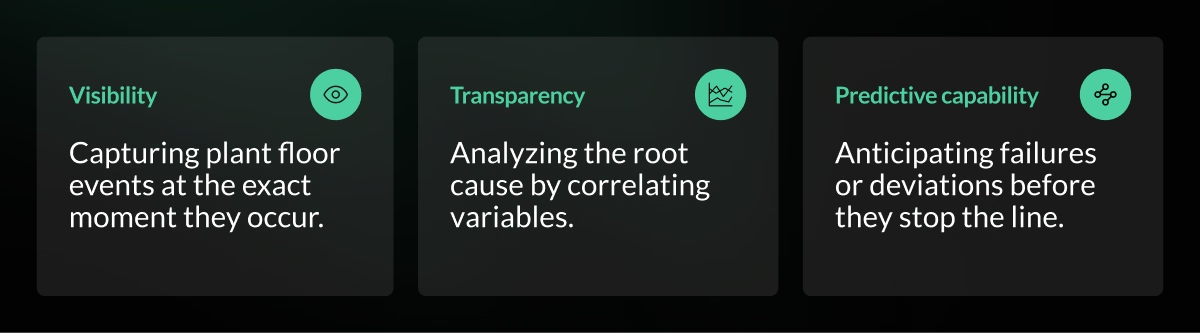
- Visibility (What is happening?): Capturing plant floor events at the exact moment they occur.
- Transparency (Why is it happening?): Analyzing the root cause by correlating variables.
- Predictive capability (What will happen?): Anticipating failures or deviations before they stop the line.
When a company relies on manual records, it gets stuck before the visibility phase. Supervisors’ decisions end up being based on perceptions (“the shift feels stable”) or analytical intuition. This is why many operations face problems such as:
- Decisions made hours after the event
- Difficulty detecting microstops or non-observable losses
- Poor coordination between production, maintenance, and quality departments
- Limited visibility into what is actually happening on the shop floor
This is where the “manufacturing intelligence” concept begins to manifest and make an important difference. For example, the adoption of manufacturing technologies for machine monitoring has allowed the entire organization—from the line operator to general management—to share a single version of the truth, eliminating information silos.
Manufacturing Based on Operational Visibility
Various international models of industrial transformation agree on a central idea: the most advanced manufacturing facilities no longer operate solely on automation, but also on data-driven response capabilities.
The Smart Industry Readiness Index (SIRI), initially developed by the Singapore government and aligned with ISO standards, defines a factory’s digital maturity based on three pillars:
- Technology
- Processes
- Organization
One of the most relevant aspects of the model is that industrial transformation does not depend solely on adopting manufacturing technology, but also on improving how people use information to make operational decisions. The same idea appears in research from the MIT Center for Transportation & Logistics and LNS Research, where the concept of Industrial Transformation (IX) describes how leading manufacturing companies are evolving from reactive operations toward prescriptive and predictive models.
How Manufacturing Technology Changes Decision-Making
Industrial digitalization is reshaping multiple levels of change and decision-making in factories. Previously, many actions depended on individual experience, manual observation, or historical reports. Modern technologies allow a real-time understanding of operational behavior and manufacturing analytics. This completely changes the speed and quality of response to production issues. Among the changes in decision-making powered by manufacturing intelligence:
Faster Responses to Operational Events
One of the most important changes occurs in reaction capability. When a machine stops and the problem only shows up in a report hours later, the ability to quickly correct the situation is limited. With modern machine monitoring systems, teams can detect stoppages, speed drops, operational anomalies, and production variations the moment they occur. This can be achieved through Andon systems, notifications sent to smartphones or computers, alerts from the system itself, and more.
Better Alignment Across Operational Areas
Another common issue in manufacturing is information siloed across systems or departments. Production, maintenance, quality, and engineering typically use different information sources, making it difficult to coordinate actions and correctly identify the root causes of a problem. Firms like Gartner have noted that one of the primary benefits of manufacturing intelligence is precisely breaking down these silos and creating a shared view of operations. When operational teams see the same indicators from a single source of truth, decision-making becomes more consistent and impactful.
Less Reliance on Intuition
Operational experience remains essential in manufacturing. However, the most advanced plants are complementing that experience with visible data and real-time analysis. Thomas H. Davenport, one of the leading figures in business analytics, has noted that data-driven organizations make more consistent decisions because they reduce reliance on isolated perceptions or subjective interpretations. This means working with operational data captured directly from machines: cycle times, machine stops, speed, utilization, production, machine status, energy consumption, and other production signals.
Systems such as SCADA, PLCs, or modern automated monitoring platforms provide more consistent information than manual records, because the data comes from operations rather than from operator interpretation or memory. In manufacturing, this translates into something very concrete: better understanding of what is affecting productivity, correct prioritization of problems, and focusing resources where operational impact is real.
The Role of Modern Digital Technologies in Manufacturing Processes
Data capture on the plant floor is not new. Systems such as PLCs, SCADA, DCS, and MES have long enabled monitoring of operational variables, equipment control, and visualization of production data. In that sense, Industry 4.0 did not invent industrial measurement. What changed was how data is captured and how it is communicated across the different assets surrounding production.
Since the mid-1970s, accessing reliable machine data required heavy infrastructure for manufacturing technology: dedicated cabling, proprietary systems, local supervision stations, complex PLC integrations for newer machines, and projects designed primarily for large companies with high automation budgets. Modern digital technologies introduce a different approach. Thanks to IIoT, the Cloud, more flexible sensors, connectivity, edge computing, and analytics platforms, it is now possible to capture data from both new and legacy machines, process it, and distribute it in real time with lower technical complexity.
This brought significant benefits to decision-making, which can be seen mainly at three levels:
1. Immediate Operational Decisions (Shop Floor)
In traditional systems, operational information was typically concentrated on physical dashboards, SCADA stations, or reports accessible only to specific personnel. This limited how quickly an operator, supervisor, or technician could react to an event. Now, when a machine experiences a microstop, drops in speed, or an unplanned event occurs, the alert no longer has to stay limited to a local screen. It can reach shop floor dashboards, smartphones, laptops, or tablets, allowing different teams to see the same event in real time. This provides visibility to multiple users at once and to work teams, while enabling better coordination. The value is not only that machine data is collected and shared across the company, but that the right people receive it even when they are not physically on-site.
2. Tactical Continuous Improvement Decisions (Operations, Processes & Production)
Traditional industrial systems could store data, but often did so in closed, local, or hard-to-integrate architectures. For example, proprietary on-premise SCADA systems and isolated historical databases by production line made it difficult to share information between departments or connect it with more modern analytics platforms. With modern cloud-based and industrial analytics architectures, machine data from multiple sources, lines, or plants can be collected, processed, and centralized in a single information layer. This allows the whole team to analyze problems or identify patterns more deeply. The advantage is not just storing more data, but being able to analyze it with greater flexibility, speed, and precision, and converting it into evidence for prioritizing improvement actions.
3. Strategic Business Decisions (Management & Finance)
Previously, operational data was often fragmented across systems, departments, or hierarchical levels. Production saw one part, maintenance another, quality another, and management received consolidated information hours or days later. Modern digital technologies reduce that fragmentation. When data is captured automatically, centralized, and visualized on accessible systems, production, maintenance, and quality teams can rely on a single source of truth and work from the same version of operations. This allows each team to understand with greater precision:
- Actual installed capacity
- Productivity losses
- Asset utilization
- Economic impact of downtime
- Real need for investment in new machinery
The difference compared to earlier technologies is that information about production can now flow with less friction, more context, and greater reliability among decision-makers. Manufacturing intelligence at its best.
Manufacturing Analytics in Continuous Improvement
International standards such as ISO 22400, which relate to Quality and OEE, mathematically defines how Key Performance Indicators (KPIs) should be structured in industry. Historically, OEE (Overall Equipment Effectiveness) has been used as the gold standard metric for evaluating productivity. In the Industry 4.0 and digital technologies space, the focus has shifted because more context and real-time manufacturing analytics are now available, helping to build a more complete picture and greater operational visibility for shop floor decision-making.
Thanks to this broader view and the use of real-time indicators available to the entire factory, decision-making has improved in critical ways. Because continuous improvement requires constant effort with clear analysis and data, accurate information from indicators is a major advantage. Metric quality matters a great deal. Their immediate availability also significantly impacts continuous improvement. After all, with outdated or poor metrics, you can never know what is really wrong. The availability of real-time machine data, metrics and analytics helps reduce effort when generating reports, allowing teams to focus more on planning solutions than on cleaning up data. It also enables clearer information on indicators that are essential for a complete operational picture:
- Leading indicators: Measure the operational variables, activities, and conditions that determine the final result. These are forward-looking metrics that allow predicting future performance. Examples: actual vs. ideal cycle time, machine stops frequency, completed preventive maintenance hours, First Time Quality.
- Lagging indicators: Measure the historical results of a process. They report what happened and are purely retrospective. Examples: OEE, total production volume, monthly maintenance cost, accident rate.
The Problem Is Not Having Access to Manufacturing Technology, but Implementing It Correctly
One of the greatest challenges of modern industrial transformation is that many digital initiatives become too complex to implement. For years, numerous digitalization projects depended on extensive PLC integrations, internal software development, costly infrastructure, or lengthy automation projects. This caused many plants to view digital transformation as a large investment and, therefore, a greater risk. However, the industry has begun to evolve toward new, less invasive solutions supported by digital technologies that enable connectivity without requiring major infrastructure changes, and that help to:
- Better understand what is happening
- Connect different types of processes
- Leverage automated machine data collection
- Use digital technologies for agile implementation
- Drive continuous improvement and productivity
And this is where Pulsar delivers a modern and effective solution for manufacturing intelligence.
Explore our platform
A Platform to Drive Industrial Productivity at Your Manufacturing Plant
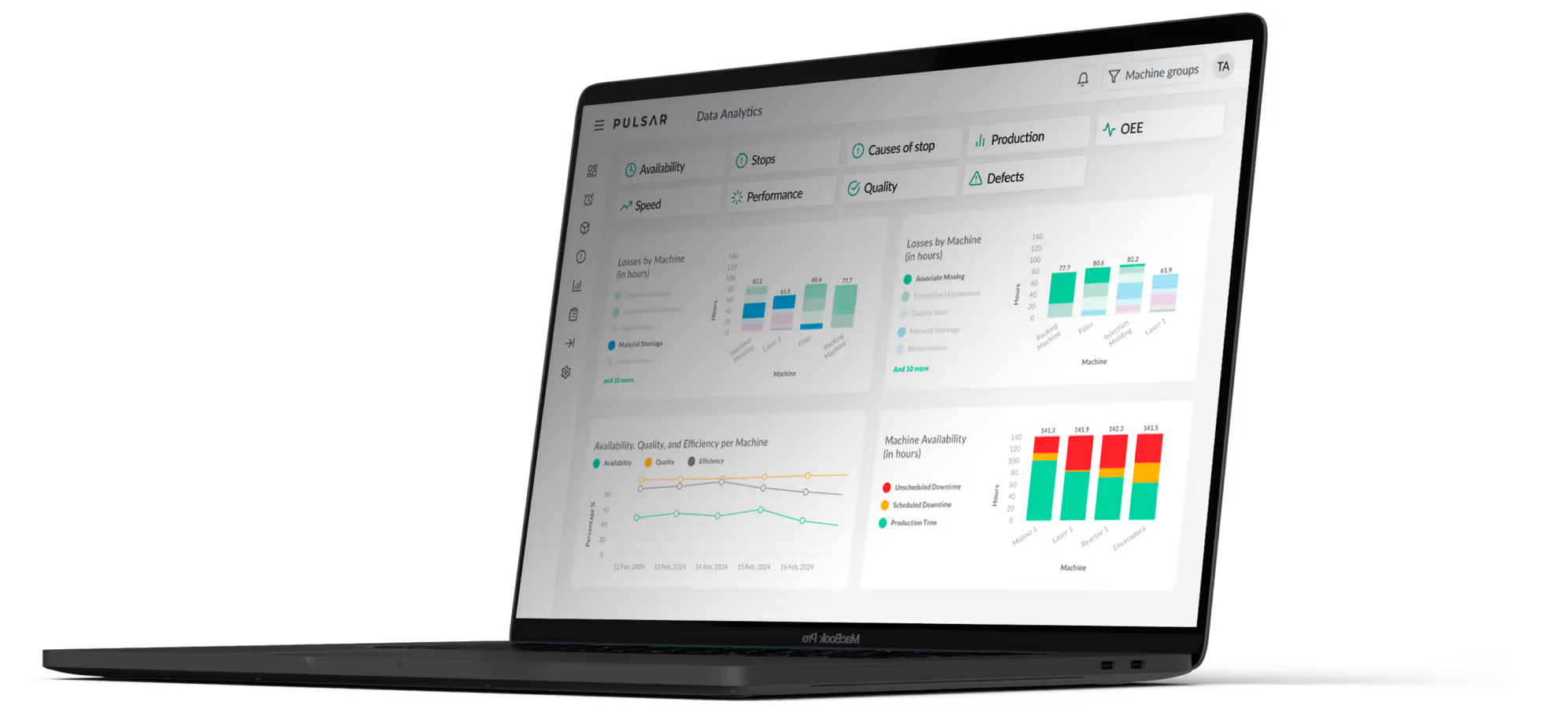
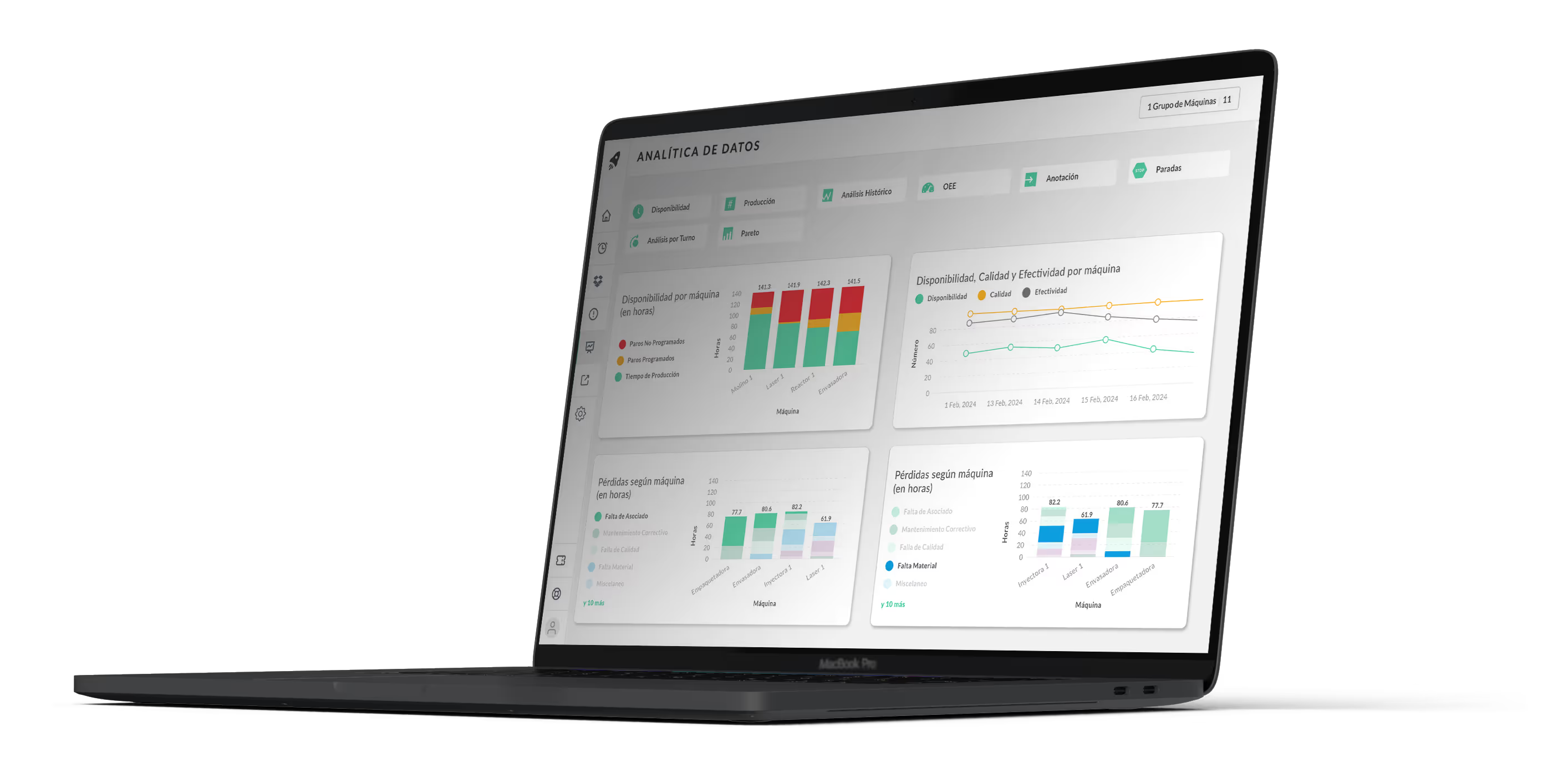
Pulsar offers an agile, modern approach for manufacturing plants. Our machine monitoring platform combines proprietary hardware and high-precision sensors with powerful Cloud manufacturing analytics software. We capture data directly from your machines—regardless of brand or age, and without depending on the PLC—and instantly transform it into visual, actionable indicators. With more than 200 plants monitored across the Americas, Pulsar helps production teams move beyond traditional technologies that, while they worked for decades, can present disadvantages compared to current options. By providing reliable, real-time data through modern manufacturing technology, we empower organizations to make fast, timely, and informed decisions that increase operational productivity by up to 30%.
The future of manufacturing competitiveness belongs to plants that make decisions based on reliable data. If you want to learn how we can help you monitor your industrial processes and make better decisions, schedule a demo of the Pulsar platform.
References
- ISO 22400: International standard that defines Key Performance Indicators (KPIs) for manufacturing operations management.
- Acatech (German National Academy of Science and Engineering) – Industrie 4.0 Maturity Index: Digital maturity model that evaluates the evolution of an industrial plant through critical phases (Visibility, Transparency, Predictive Capability, and Adaptability) based on its decision-making.
- Smart Industry Readiness Index (SIRI): Global reference framework developed in alignment with ISO standards to determine a factory’s digital maturity across the pillars of Technology, Processes, and Organization.
- MIT Center for Transportation & Logistics / LNS Research – Industrial Transformation (IX): Research and strategic models focused on the evolution of industrial plants toward prescriptive and predictive operations.
- Gartner: Global consulting and research firm that defines the impact of modern operational intelligence systems for breaking information silos in manufacturing environments.
- Thomas H. Davenport: Author and leading figure in business analytics, recognized for his contributions on the transition of organizations toward consistent decisions based on data rather than subjective interpretation.
- World Economic Forum (WEF) – Global Lighthouse Network: Global network that identifies and analyzes the world’s leading manufacturing plants for their adoption of Industry 4.0 technologies.
Related articles

Request a Custom Demo
See how Pulsar’s manufacturing intelligence platform can help your operations today.