
The Impact of Artificial Intelligence on Manufacturing Operations
Artificial Intelligence has become an essential concept when discussing modern manufacturing technologies. Its value lies in its ability to help in complex environments and improve decision-making for manufacturing operations. Below, we review the concept and its benefits for manufacturing companies in a step-by-step guide.

Content
To understand the role of Artificial Intelligence (AI) in manufacturing operations, we first need to differentiate it from traditional approaches. For decades, Programmable Logic Controllers (PLCs), SCADA systems, and Distributed Control Systems (DCS) have done an extraordinary job executing preprogrammed logic. For example, if a sensor detects a variable outside its range, the system stops the machine.
AI adds an extra layer of information for manufacturing operations. While traditional supervisory systems focus on visualizing operational information, Artificial Intelligence algorithms identify complex relationships among multiple production variables. In short, AI uses the information your industrial systems already generate to identify those relationships and support decision-making.
Use cases for AI in manufacturing
The strategy consulting firm McKinsey & Company points out that advanced analytics is changing the timeline of operational management. Traditionally, shop floor analytics has been descriptive: it answered the question "What happened in the previous shift?" through historical reports.
Real-time monitoring advanced toward diagnostic analytics ("What is happening now?"). However, AI has impacted both manufacturing and production by bringing predictive analytics ("What will happen next?") and prescriptive analytics ("What should we do now?") to industrial operations.
There are many AI tools for manufacturing with different scopes; below are a few examples of AI's impact on the prescriptive side of things:
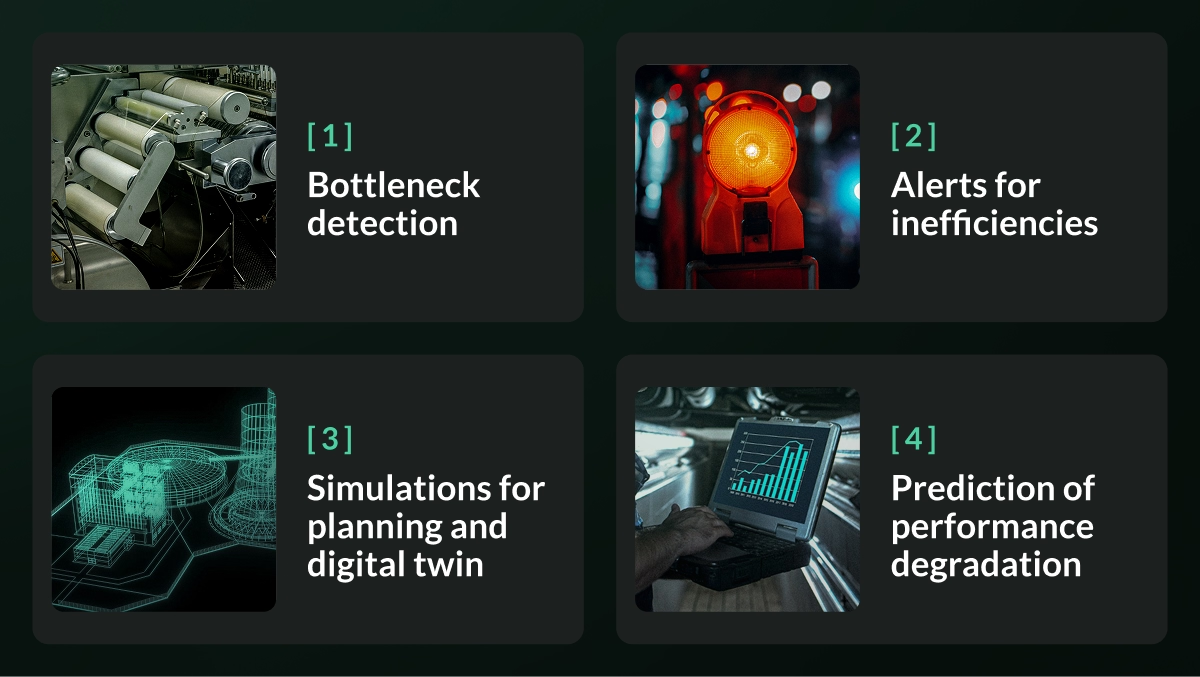
- Bottleneck detection: By analyzing data and patterns during operating shifts, AI can diagnose potential bottlenecks on production lines and issue recommendations to optimize processes.
- Alerts for inefficiencies and/or abnormal events: Once AI understands your processes and production times, it can flag and alert you when a production process is not operating at the speed or precision it should.
- Simulations for planning and digital twin: AI can produce production estimates based on adjustments to the environment and other variables to anticipate the outcome of specific decisions or conditions, and offer visualizations through scenario simulators (digital twin).
- Prediction of performance degradation: Identifying early when a machine begins to operate below its expected cycle time due to miscalibrations.
Key example: Automated quality inspection through computer vision
As a key AI tool for manufacturing, computer vision deserves a separate mention, since it plays a critical role in quality control processes.
Computer vision systems can analyze images in real time to detect surface defects, verify assemblies, or automatically classify products. In the food industry, for example, these solutions are already used to classify fruit and other products according to characteristics such as size, color, shape, or visible defects, making it possible to maintain consistent quality standards at high speed.

Manufacturing intelligence: How AI finds patterns that go unnoticed
Unlike traditional analysis methods, AI can simultaneously evaluate hundreds or thousands of operational variables to identify relationships that would be extremely difficult to detect manually. It does not limit itself to observing a single isolated signal; instead, it analyzes how multiple factors interact within manufacturing processes. In other words, it brings true manufacturing intelligence to day-to-day operations.
For example, it can discover that certain performance losses occur only when specific operating conditions, shift changes, or particular machine configurations coincide. These types of patterns often remain hidden even from highly experienced teams, simply because the volume of information exceeds human capacity.
The problem is no longer a lack of information, but an excess of data
It is often thought that factories need more sensors to become smarter. The reality is the opposite: modern industrial facilities and factories are flooded with information. Between machine data generated by PLCs, MES systems, and SCADA, energy meters, and shop floor sensors, a single production line can generate thousands of data points per minute.
This is where the human limit arises. A production supervisor or a continuous improvement engineer cannot process such a volume of variables simultaneously and instantly while attending to incidents on the shop floor.
Thomas H. Davenport and John C. Beck have pointed out that, in an environment where information is increasingly abundant, the truly scarce resource is human attention. Something similar happens in manufacturing operations: a production line can generate a continuous volume of signals from PLCs, sensors, energy meters, and other industrial systems, but supervisors and engineers have limited time to interpret and act on them. In this scenario, AI helps filter large volumes of data, identify relevant anomalies, and prioritize the information that requires immediate attention, enabling faster and better-informed decision-making.
The quality of an artificial intelligence depends on the accuracy of its data
A question that comes up constantly is whether implementing artificial intelligence in manufacturing operations is synonymous with success. However, Gartner has predicted that, through 2026, organizations will abandon 60% of AI projects that do not have AI-ready data. More than the algorithm, the main obstacle usually lies in the quality, availability, and readiness of the data. In the AI ecosystem there is a widely known golden rule: "Garbage in, garbage out." In other words, if garbage data goes in, garbage results come out.
If a production team tries to feed an AI model with:
- manual paper records prone to omissions,
- spreadsheets with incomplete data or entered hours later,
- inconsistencies in recording the real causes of downtime,...
then the system will learn from false information and will run the risk of generating incorrect diagnoses. For this reason, both manufacturing intelligence and successful AI models require good operational data, such as machine data or data collected by machine monitoring systems.
Explore our platform
The real challenge: Collecting machine data across heterogeneous environments
When a company decides to move forward with implementing AI and manufacturing intelligence projects, it runs into the industry's most complex technical challenge: the heterogeneity of the shop floor.
A typical shop floor does not have identical machines or machines from the same generation: equipment from different manufacturers, of different ages and levels of automation coexist, each with different communication protocols, PLCs without access, or, in some cases, without any native connectivity capability at all. This is very common, particularly in sectors such as metalworking or mining. Different technologies may coexist on the shop floor, and many may leverage machine data, though only partially. In these scenarios, legacy machines tend to be left behind and disconnected, even when they are still productive and critical to operations.
Trying to unify this “Tower of Babel” situation through traditional integration projects usually requires months of development, custom software, and high operational risk. The challenge is not only capturing machine data, but doing so consistently in operational environments where different machines and manufacturing processes coexist.
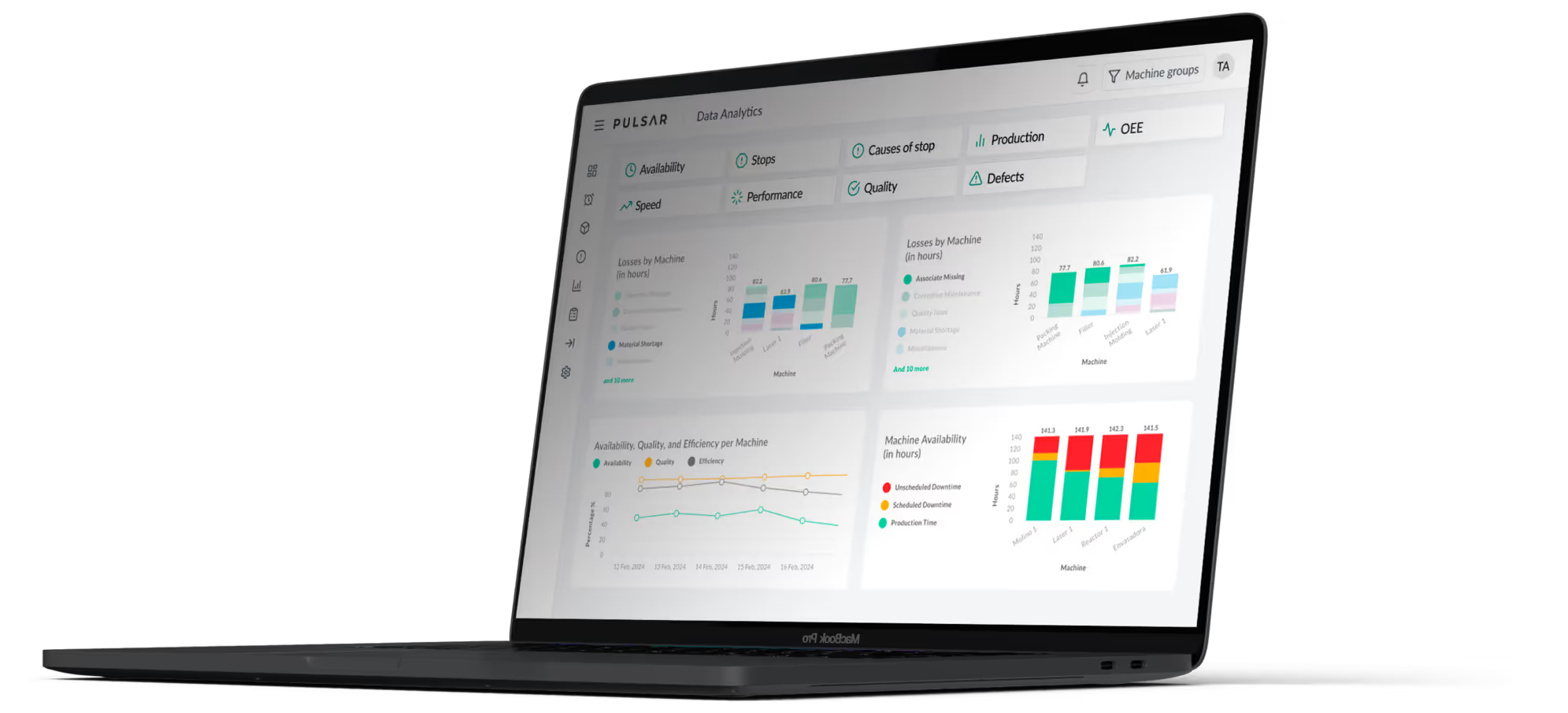
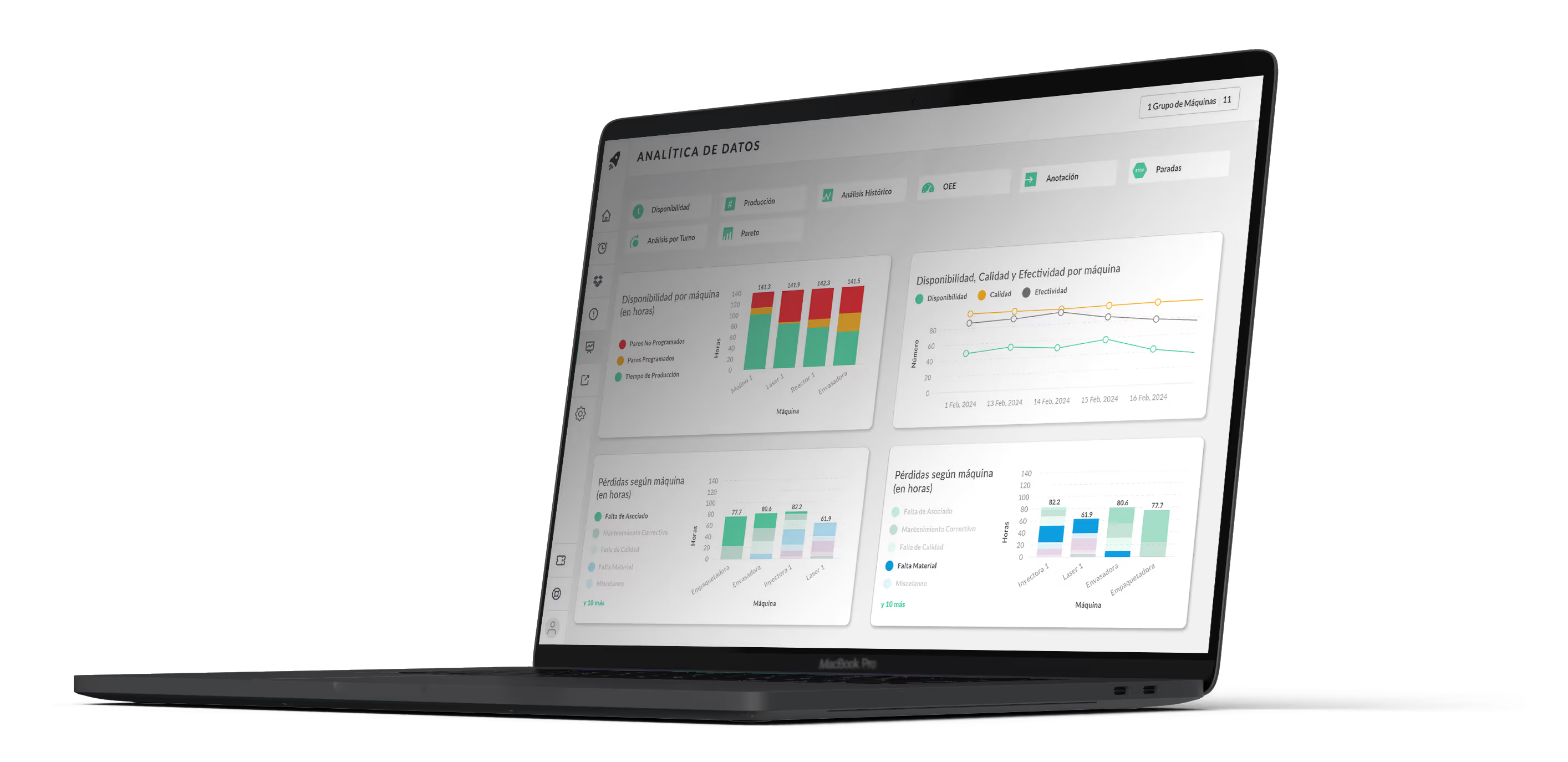
This is where a manufacturing intelligence platform like Pulsar offers a more agile, practical, and modern alternative. Instead of forcing complex integrations or intervening in your equipment's PLCs, Pulsar uses an agile, non-invasive approach: we combine our own adaptable hardware for manufacturing data collection and industrial sensors that adapt to any type of machine, regardless of its brand or age. This gives visibility into all types of machines and processes, generating reliable machine data for decision-making through technologies such as AI.
Why data must come before AI in manufacturing operations
Although everyone talks about AI tools for manufacturing, few stop to analyze the information infrastructure and operational visibility needed to sustain it. Artificial Intelligence is not a magic wand; it is the roof of a structure whose foundations are accurate, real-time data.
Success—or efficiency, or better control—in manufacturing operations is not achieved by implementing complex algorithms overnight. It begins with something far more practical and urgent: ensuring that every moment your machines and processes are operating translates into clean, transparent data.
If you are interested in implementing AI in manufacturing operations, Pulsar can help. Our machine monitoring system captures data automatically from your machines and gives you full process visibility. It provides your engineers, supervisors, and operators with the clarity they need to optimize processes, eliminate hidden losses, and increase productivity. That clarity is the stable foundation any AI layer is built on.
Related articles

Request a Custom Demo
See how Pulsar’s manufacturing intelligence platform can help your operations today.