Production Monitoring Software: Real-Time Insights for Production Lines
Whether you’re running a beverage bottling line, managing high-pressure injection molds, or stamping metal at scale, every second counts. With Pulsar’s Production Monitoring Software, you can stay on top of fast-moving operations by tracking machine performance, cycle times, and downtime in real-time.
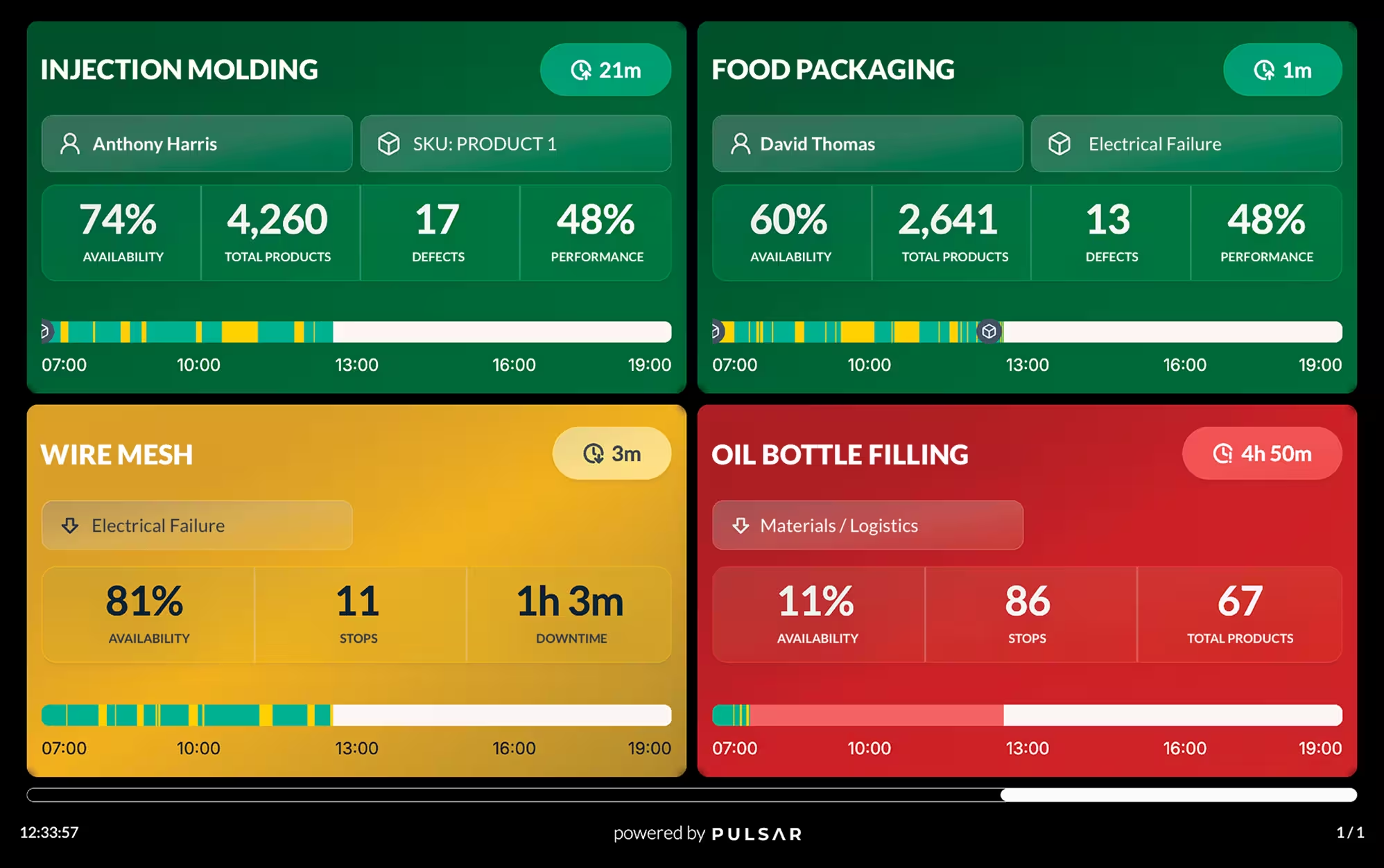

Keep your production lines running smoothly—from anywhere
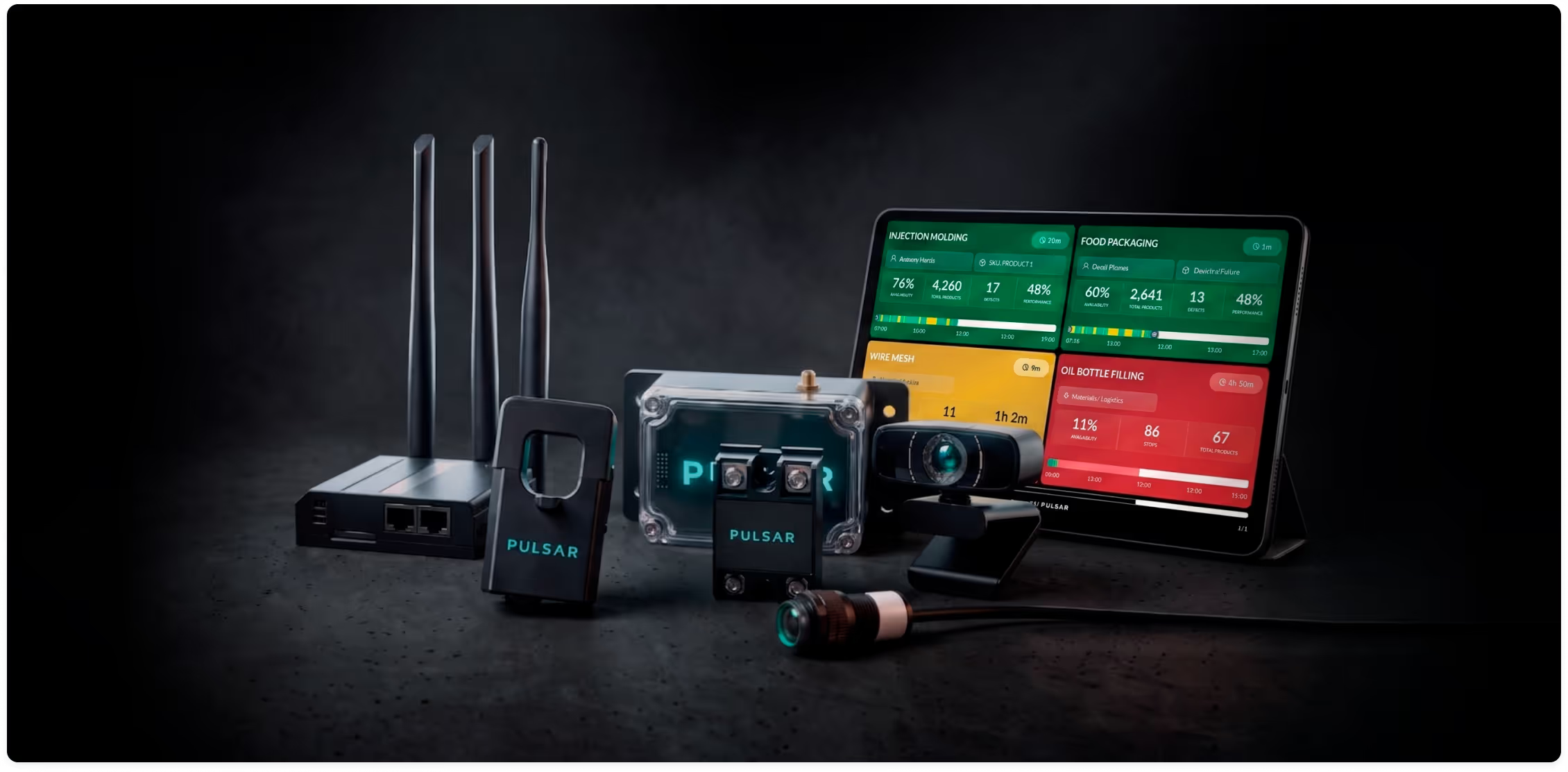
Monitor industrial processes and how fast and efficient are your machines with an specialized software.
Let your team know whenever there’s an issue on the plant floor. Get push notifications, SMS or email notifications in seconds.
Access historical data and root cause reports to support production optimization and informed decisions.
Production dashboard in real time
All your data, one live production dashboard, accessible from your laptop or TV screen. Leveraging our industrial sensors, we can connect to older and newer machines, as well as automatic and semiautomatic production lines. Monitor speed, output, OEE, cycle times, production, and unplanned downtime with precision without complex installations or interfering with PLCs.
Lack of visibility on shop floors? Try our real time production dashboard.
When your production isn’t reaching goals, it’s not just missing output: it’s lost visibility. Without real-time data, you’re left guessing which machine is dragging you down or why a shift underperformed. Pulsar’s Production Monitoring Software gives you clarity on what’s happening in every shift through real time production dashboards and automated metrics. It helps you understand better how your critical machines and lines operate, so you can stop reacting to symptoms and start fixing root causes.
A lack of shop floor visibility is often caused by manual data collection, where information is recorded on paper or spreadsheets and reviewed only after the fact, leading to delays and inaccuracies. It is also common for production data to be spread across disconnected systems, with machines and software that do not communicate with each other, preventing a unified view of operations. On top of that, having different definitions of key metrics (which tends to happen when you have different machines) across teams make reports difficult to compare and analyze, limiting their value for decision-making.
Whether it's a bottle filler that's lagging or an injection molding machine with unplanned stops, Pulsar allows you to monitor your plant floor and capture your machine performance. With instant alerts and historical reports, your team gets the clarity they need to act fast and drive production optimization and continuous improvement. Let data lead the way.
Benefits of Production Monitoring Software
- Know what’s happening—now.
View live production metrics from any device. Track each machine, each shift, and each line with minute-level precision. - Respond without delay.
When something breaks down or slows down, everyone knows through notifications, alerts or a visual interface. No need to dig through paperwork or wait for reports. - Make decisions with confidence.
Use real-time and historical data to optimize your production, plan your shifts, and enhance the productivity of your existing assets.

What is a production tracking software?
Pulsar's production tracking software gives you real-time visibility into how your machines are actually performing, not how you think they’re performing. Instead of relying on shared knowledge, paper logs, or monstrous Excel files, Pulsar gives you live data on uptime, speed, output, and more.
Today, almost every manufacturing plant has some form of production data, but that does not mean the data is high quality or truly useful. Good production data is accurate, real-time, and actionable. It does not just tell you what happened after the fact, it tells you when it happened, where it happened, and why it happened.
High-quality data is tied directly to machines or specific production processes, removing interpretation and manual bias. More importantly, it captures key metrics in a consistent and standardized format that is easy for the entire team to access, understand, and use. When data is reliable and clear:
- Everyone, from top to bottom, knows what's happening on the shop floor
- Teams have more information and precise data to make faster and better decisions
- Production, maintenance, quality and support are aligned on priorities
- Teams can focus on improvements that actually move production forward
Pulsar can enable data collection from your machines or production lines without interfering with PLCs and shows you exactly where your production is losing efficiency. Production tracking focuses on machine data, automating collection and making it easier for your team to understand what happened.

Production Monitoring: Key Benefits
Traceability and visibility of operations
Live production monitoring and automated logging capture everything that happens on the floor in a clear, objective, and consistent way. This makes it easier to identify exactly where quality issues started, understand why a machine went down, and see how events unfolded over time. You can also review what really happened during a night shift or off-hours run through automated production dashboards and reports, without relying on manual notes or chasing people down for explanations.


Production optimization & continuous improvement
Real-time production tracking software gives teams precise, neutral data directly from the machine, creating a reliable foundation for decision-making. Instead of relying on assumptions or periodic reports, you receive a constant stream of input from the plant floor that reflects what is actually happening in real time. This data enriches daily workflows and continuous improvement programs, making them more grounded and actionable. As a result, teams can test changes, iterate faster, and optimize production processes with greater confidence, agility, and consistency.
Agile Communication for high-volume operations
In high-volume operations, even small delays can quickly ripple across your production lines and impact overall output. Real-time production monitoring keeps teams aligned by instantly flagging issues as they occur, rather than after the fact. With immediate visibility and shared production dashboards, operators, supervisors, and maintenance teams can react faster, coordinate more effectively, and take action before minor disruptions turn into major losses, helping keep lines running at full speed.

Keep control of your processes
Pulsar helps manufacturing companies that want to increase output and drive production optimization. By providing a single platform to manage and analyze productivity data, it supports the creation of a single source of truth for your processes and makes it clear where to focus to improve.
Monitor any machine, regardless of process, age, or model

Doypack, case packers, canning machines, baggers, and more.

Liquid fillers for food, chemicals, and beverages.

Injection molding, blow molding, thermoforming, extrusion, recycling, and more.

Presses, benders, welders, punch presses, laser cutters, and more.

Welders, shears, benders, presses, aluminum injectors, and more.

Assembly, glass, electronics, textiles, printing, and more.
How we drive growth with our cleintes
Results achieved by our clients using our production monitoring software.








Get complete, accurate, real-time production monitoring with Pulsar

Enable real-time monitoring for any machine—regardless of type, model, or age, without interfering PLCs.

We collect data automatically and make it accessible to your team from a single, intuitive platform.

Our platform can be installed in a single visit, requires minimal setup, and includes technical support.
Frequently Asked Questions
A successful production report starts with OEE and the metrics that explain it: parts produced, cycle times, speed, productive periods, machine stops, and target attainment. Without them, the report tells you how much you produced but not why. It should also let you compare machines, lines, shifts, and periods. That's how you spot inefficiencies and see where production capacity is being lost.
With Pulsar, this data is captured straight from the machine and centralized in automated reports. You don't have to rely on manual records put together at the end of the shift.
The metrics depend on the process and the plant's goals. They usually include OEE, availability, performance, cumulative output, speed, cycle time, and the number and duration of machine stops. Together they tell you whether a line is keeping the expected pace, and they help you catch inefficiencies before the shift ends.
To improve them, set a baseline per machine and shift. Prioritize the losses that add up to the most time, make corrective actions, then use those same metrics to check whether each action worked. Pulsar's OEE software lets you review more than 25 key production metrics from one platform.
Real-time production monitoring shows what's happening on the machines during a shift. It also sends alerts when an inefficiency or machine stop happens. A production report consolidates data over a period so you can compare results, identify patterns, and evaluate target attainment.
The two work together. Monitoring supports the immediate response of the production, maintenance, and quality teams. Reports make historical analysis and continuous-improvement follow-up easier.
Look at four things. Does the software capture machine data automatically? Does it work with all your machines without touching the PLC? Does it log the causes of machine stops? And does it give you history so you can compare periods? Without that, planning still runs on estimates.
Pulsar lets you compare real progress against shift targets. It detects machine stops and speed variations, and it shares up-to-date information with the production, maintenance, and continuous-improvement teams. That makes it easier to prioritize problems, coordinate the response to events, and react in time to hit shift targets.
Machine monitoring gives plant managers and the production team the detail they need to make better decisions and act in time.
Yes. Pulsar uses sensors, capture devices, and smart cameras to collect data externally. It can monitor different machines without modifying their PLCs. That means you can leverage production dashboards and automated reports even on older or conventional machines that don't readily share operational data.
Review the duration, frequency, timing, and affected machine for each machine stop. Compare how it behaves across shifts and periods. This shows you which events keep recurring, so you can prioritize the ones that add up to the most lost time. Automated production reports can be generated in seconds, so your team doesn't waste time pulling data together.
Pulsar's historical data gives you evidence to investigate the causes of machine stops. It also lets you confirm whether the actions you put in place reduce how often they recur.
Yes. Pulsar collects and centralizes data from machines of different processes, models, and ages, including automatic and semi-automatic lines. You review different production metrics on one platform and compare the performance of machines that normally report information in different ways.

Request a custom demo
Discover how our production monitoring software can help you to optimize your manufacturing processes.